 Ethan+
You Were Given Infinite Creative Power and You're Spending It Making Things You Don't Care About
You have more creative power than Da Vinci, Spielberg, and The Beatles combined. That's not a metaphor. A single person with AI can now do what used to require entire studios, orchestras, and dev teams. And you're using it to build something you wouldn't want to be remembered for.
- Published
- February 4, 2026
- Reading time
- 9 min read
- Author
- Ethan Rogers
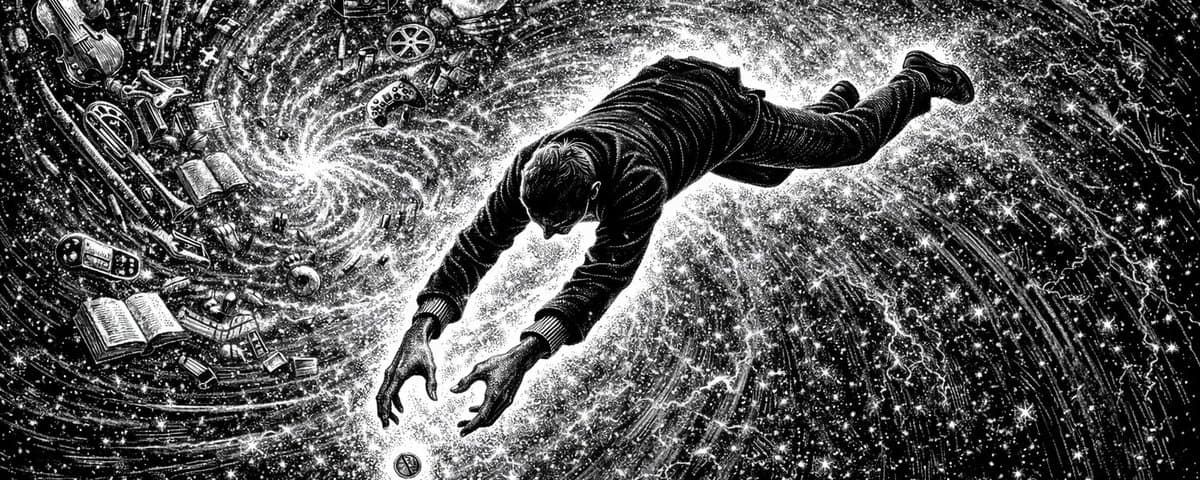
You have more creative power than Da Vinci, Spielberg, and The Beatles combined. That's not a metaphor. A single person with AI can now do what used to require entire studios, orchestras, and dev teams. And you're using it to build something you wouldn't want to be remembered for.
The Gap
For as long as humans have existed, there has been a gap between what a person could imagine and what they could actually create.
Every painter had a vision their hands couldn't fully translate. Every musician heard compositions they couldn't play. Every filmmaker saw scenes they couldn't afford to shoot. Every kid who sketched a video game in a notebook during math class knew, on some level, that the thing in their head would probably never exist.
This gap is the defining constraint of human creative history. Not talent. Not resources. The distance between "I can see it" and "I can build it."
Da Vinci had ideas for machines he couldn't build. Not because the ideas were bad. Because the tools didn't exist. Entire generations of musicians died with symphonies in their heads they never had the training or the instruments to bring to life.
How many games, films, albums, inventions, and worlds have existed only inside someone's skull and then just disappeared when they did?
Billions, probably.
The vast majority of human creative vision has died unbuilt. Not because people lacked imagination. Because they lacked the means to close the gap.
AI closed the gap.
Not narrowed it. Closed it.
For the first time in history, the distance between "I can imagine it" and "I can create it" is approaching zero. And that is so fundamentally reality-altering that most people's brains just haven't processed it yet.
What One Person Can Do Right Now
A single human being with a laptop can now:
Build a complete, playable video game with mechanics, art, sound, and story. The kind of thing that used to require a studio of 50 people and 3 years of development. Done in weeks.
Produce a professional-sounding album without ever learning an instrument or stepping into a studio.
Create a film that would have won awards at a festival 10 years ago. The tools are improving monthly.
Write and illustrate a book. Cover, interior art, layout, formatting, publishing pipeline. One person.
Design and ship real, complex software that would have required a dev team and six months of sprints.
Build entire worlds. Lore, maps, characters, visual identities, interactive experiences.
People are doing all of this right now.
But most aren't. Most people with access to these tools are using them to build another project management app. Another AI wrapper. Another "automate your outreach" tool. Another thing they have zero emotional connection to, for a market they're not passionate about, in pursuit of a revenue number that's become the default definition of success.
The SaaS Illusion
I want to talk directly to the thousands of people grinding on a micro-SaaS right now, struggling to break $1,000 a month.
You are sitting on skills that businesses will pay $5,000 to $10,000 a month for. Right now.
There are millions of businesses that haven't touched AI yet. They don't know how to automate their operations, build internal tools, or set up AI-powered workflows. They need someone to do it for them and they will pay real money. Not $29/month subscription money. Thousands per month, per client, on retainer.
Instead of spending six months trying to get strangers to pay $19/month for a tool they'll churn out of in 60 days, you could land two clients this month and make more than most SaaS builders make in a year.
The skills are the same. The effort is less. The money is dramatically better.
But people don't do it because it doesn't look as cool on Twitter. "I help businesses automate their operations" doesn't hit like "Just crossed $2k MRR on my AI wrapper." So they chase the vanity metric and ignore the obvious play right in front of them.
And here's the deeper truth nobody in the SaaS space wants to hear.
SaaS as we know it is dying.
As AI gets more capable, the entire concept of paying monthly subscriptions for software falls apart. Why pay $49/month for a project management tool when your AI can build one, customized to your exact needs, in an afternoon? Why subscribe to a CRM when you can generate one that fits your specific workflow perfectly?
The subscription model relies on a world where building software is hard. AI is making it easy. Every month the tools get better, and every month the moat around "I built a thing you can subscribe to" gets thinner.
People are spending their creative energy on things they don't care about, built on a model with a shrinking shelf life. That's two bad bets stacked on top of each other.
One Hour a Day
Here's something that sounds unrealistic but isn't.
You can solve your income problem in about one hour a day.
AI agent systems can handle the code, the copy, the marketing, the customer support, the operational overhead. You set up the systems. You point them in the right direction. You check in for an hour a day to make sure everything's running. That's it.
Whether it's a couple of high-value consulting clients, a simple automated product, or an AI service you offer to businesses that are behind on technology, the structure is the same. Build the system once. Let the agents run it. Show up for an hour to steer.
This isn't about building a billion-dollar company. It's about covering your expenses. Paying your rent. Handling your bills. Then getting on with the thing that actually matters to you.
The 4-hour work week required outsourcing, delegation infrastructure, and a lot of privilege. One hour a day with AI agents requires a laptop and the willingness to set it up.
Income is no longer a lifestyle. It's a chore. Handle it like one.
Which brings us to the only question that actually matters.
The Question You've Never Really Answered
If money wasn't a factor, what would you actually want to do with your life?
Most people think they know the answer to this. They don't.
Here's why. We live in a world where money has been tied to survival since the day we were born. Every decision you've ever made has been filtered through the question of "but can I make a living doing this?" You chose your career through that filter. You chose your hobbies through that filter. You even chose what you allow yourself to dream about through that filter.
So when someone says "I love what I do," there's a question worth asking: do you love it, or did you learn to love it because it was the thing that also paid the bills?
There's a difference between genuine passion and rationalized comfort. A lot of people have spent years convincing themselves that the thing they do for money is the thing they'd choose to do with total freedom. Because the alternative is too painful. The alternative means admitting you've been spending your time on something that isn't really it.
Think about it this way.
If you woke up tomorrow and money was handled forever. Not just "comfortable." Handled. You will never need to earn another dollar. Your bills are paid. Your family is taken care of. It's done.
What would you do on day one?
Not day one hundred, after the vacation wears off. Day one. What pulls you? What's the thing you'd start building, making, or exploring before anyone told you it was a good idea?
For most people, the answer has nothing to do with their current work. It's the game they've had in their head since middle school. The album that doesn't fit any genre. The animated series they've been mentally writing for years. The book that's been half-formed in their mind for a decade. Something they can't fully articulate. Just a feeling, an aesthetic, a world that wants to exist.
That answer, the one that shows up before your brain starts rationalizing, is the real one.
And for the first time in history, you can actually pursue it. Not as a fantasy. As a Tuesday.
This Is the New Reality
I want to be clear. This is not a limited-time opportunity.
This is a permanent shift in what it means to be a creative person. And it's only going in one direction.
As AI advances, the thing that matters most will be the quality of your ideas. Your taste. Your vision. Not your technical ability. Not how fast you can ship. Not how well you can grind. The people who win long-term will be the ones who actually have something original to say.
The boring stuff gets easier every day. The automation gets better. The execution gap keeps shrinking. What doesn't get automated is the part that's uniquely yours. The strange idea nobody else would have. The combination of influences that only exists in your head. The creative instinct that comes from your specific life and your specific perspective.
The era of "I'm valuable because I can build the thing" is ending. The era of "I'm valuable because I can imagine the thing" is here.
Most people are still on the old playbook. Grinding on execution for projects they don't care about while their best ideas collect dust.
So Here's What I'm Saying
Treat your income like a problem to solve, not an identity to build.
Fix it. Automate it. Minimize it. Set up your systems, check in for an hour a day, and stop making it the center of your life.
Then take every remaining hour and pour it into the creative work that's been living inside you. The stuff that doesn't have a business model. The stuff that's weird and personal and might not scale. The stuff that, when you're 80 years old, you'll actually be glad you made.
Nobody on their deathbed wishes they'd built one more SaaS.
But a lot of people will wish they'd built the thing they actually cared about when they had the chance.
You have the chance. The tools are here. The gap is closed.
The only question is whether you're going to use it.
Dispatches
A note when something ships or when there is something worth reading.